Ispahan, Two Years & Too Many Eggs Later
 The first time I tried making macarons was about two years ago, when I first laid hands on Pierre Hermé's Chocolate Desserts. Obviously, I hadn't done enough homework at that point. Or I would have realised two important things:
1) Macarons are tough cookies to master.
2) Chocolate macarons are the toughest macarons of all to master.
As for the unmitigated disaster that ensued - caused by my very own hubris and ineptitude, as opposed to the recipe's or book's soundness, both of which are unimpeachable - I not only wept with frustration, but also there and then swore off ever attempting macarons again. And I am usually not one to be easily dissuaded.
Of course, not everybody is culinarily challenged in the macaron department. Far from being stumped, some are veritable virtuosos. For happy tales of (and expert tips on) macaron making, be inspired by Clement - the blogosphere's very own macaron maestro - or Melissa's mighty macarons (to mighty, add marvellous and magnificent).
This tale, on the other hand, is 99% sweat and tears. Does time heal all wounds? I don't think it's so much a matter of healing but a matter of forgetfulness. For surely the smart of those unspeakably odious first results - clumsy feetless poufs that looked like a circus mirror distortion of the elegant, just-domed, frilly-footed thoroughbreds - must have become a distant fuzzy memory; why else would I have mustered the nerve to go anywhere near a macaron recipe again after all this time?
Then again, pertinaciousness and pride do have a nasty habit of manifesting themselves in an irrational manner. Once bitten, twice apparently not shy. In this particular instance, in a masochistic display of macaron bravado - "I will be the master of the recipe! The recipe will not be the master of me!" Albeit this time round, I've had the uncommon good sense to start with something other than the macaron of macarons, the king of kings, the chocolate macaron. This notwithstanding, I've just spent the better part of two days making batch after batch of macarons, every single one chucked down the chute bar the last. Taste, right; look and texture, all wrong. Chuck. Nice smooth dome; no feet whatsoever. Fold batter one turn too many; dense hockey pucks. Didn't fold batter quite enough; peaked poufs of meringue. Chuck, chuck, chuck. (For yet more examples of all sorts of sticky situations you might get yourself into, and advice on avoiding these pitfalls, see this thread and this thread on eGullet - you'll find almost all you need to get all tricked out, from "ageing" egg whites at room temperature for a day or so to waiting 2 hours for skins to form on the piped batter.)
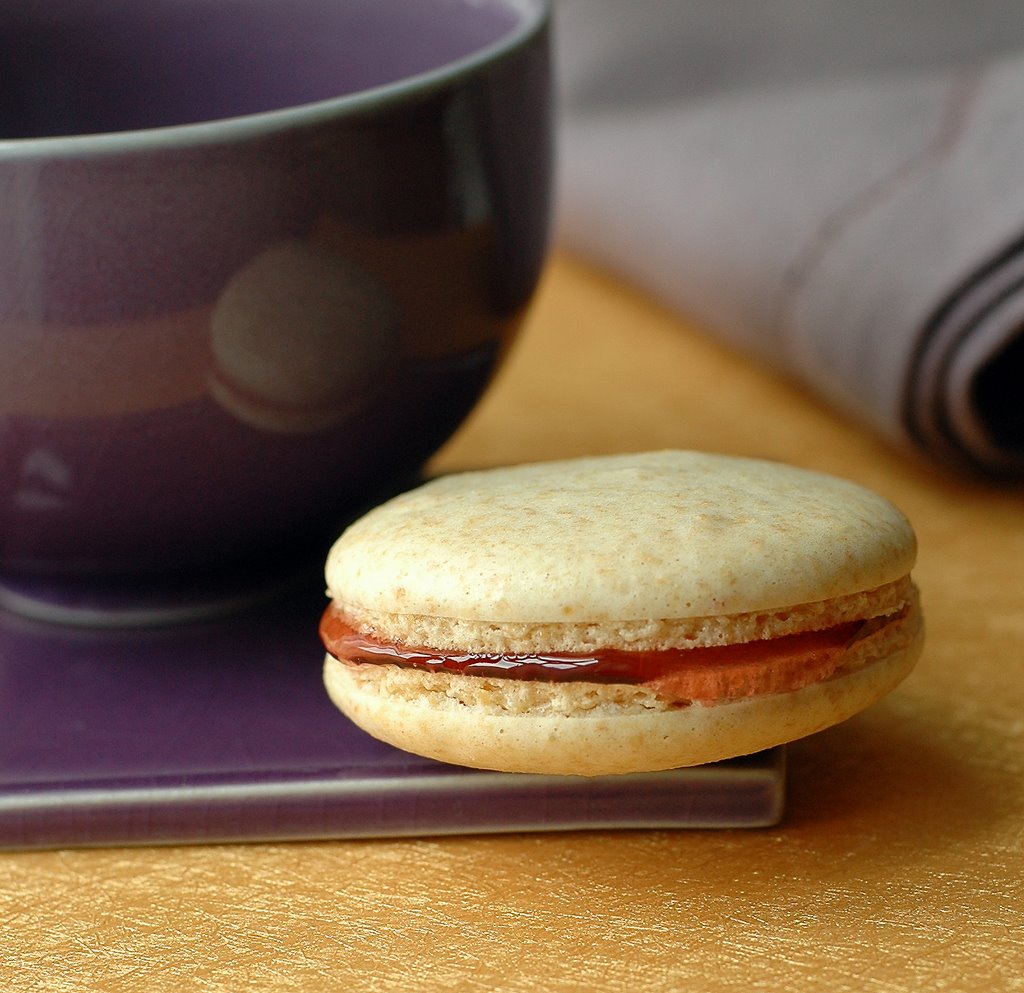
I was determined not to run out of patience. What I didn't foresee was running out of egg whites. Then suddenly, just as I was resigned to the prospect of dashing out in the muggy weather to buy yet more eggs, with the last batch made with the whites of my last three eggs, the pastry gods finally managed a wicked smile at the self-flagellation wrought, the stars came into alignment, and it all fell into place. I rubbed my tired eyes, convinced I may have been hallucinating at the sight of those little pink babies rising ever so slightly whilst obediently forming the requisite little skirting at their feet - afterall, I hadn't really slept the night before, and not because I was in bed tossing and turning (when I said two days, I meant two days). A macaron puts paid to that old adage that appearance isn't everything. Here, looks speak volumes; the smoothness of the dome, the slightness of its curvature, the formation of feet - all are visual clues that indicate the texture will possess the desired interplay, that between an eggshell-thin crust that's delicately crisp, giving at the slightest pressure, and a crumb that's soft, moist and slightly chewy. All tell you that the batter had been mixed just so, and has thus risen just so.
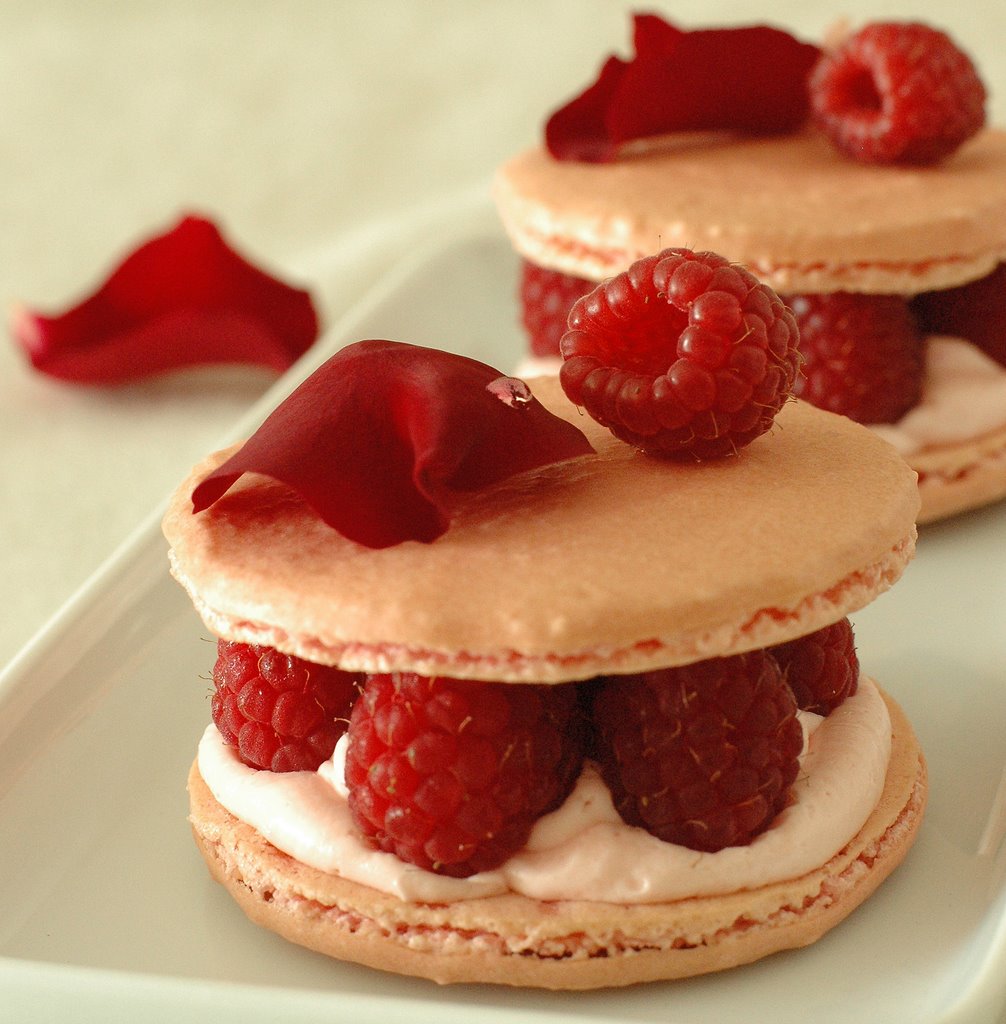
Tremendously relieved rather than triumphant (ok, maybe just a little...), I've neither been more humbled by a baking experience nor more impressed upon the truism that practice makes perfect, learning a new lesson or two with each and every mistake made. The macaron fancy I had sought to emulate is Pierre Hermé's signature Ispahan - a pair of rose macarons sandwiching a cushion of rose scented buttercream crowned with raspberries and lychees. Having eaten more than my fair share of famously fabulous macarons, I'll be the first to admit that the specimens I produced were far from textbook perfect. That, I have no doubt, will have to be paid for in yet more sleepless nights and trays of eggs. Nonetheless, they were at least of a decency that I wouldn't have qualms about serving friends and family without feeling like a sloppy cook.

The recipe I loosely based my attempts on comes from the Summer 2005 issue of Art Culinaire (in case you're interested, there's also an on-line version), using it more as a template really rather than a straightforward recipe - there's a fair bit of reading between lines and filling in blanks involved. I had flavoured the rose components of the dessert using rose syrup (readily available here; I simply adore the old-fashioned packaging!) and rose water. The macaron and buttercream components tasted plenty rosy by themshelves, but didn't sufficiently stand up to the tartness of the raspberries in the finished dessert. To redress the balance, the solution doesn't lie in adding more rose syrup (which would make things too sweet) or rose water (which would alter the liquid balance). To this end, the next obvious phase in my plan of action, I've just found myself the perfect excuse to go invest in some Sevarome natural rose paste.
posted by Joycelyn at Tuesday, April 04, 2006
28 comments